

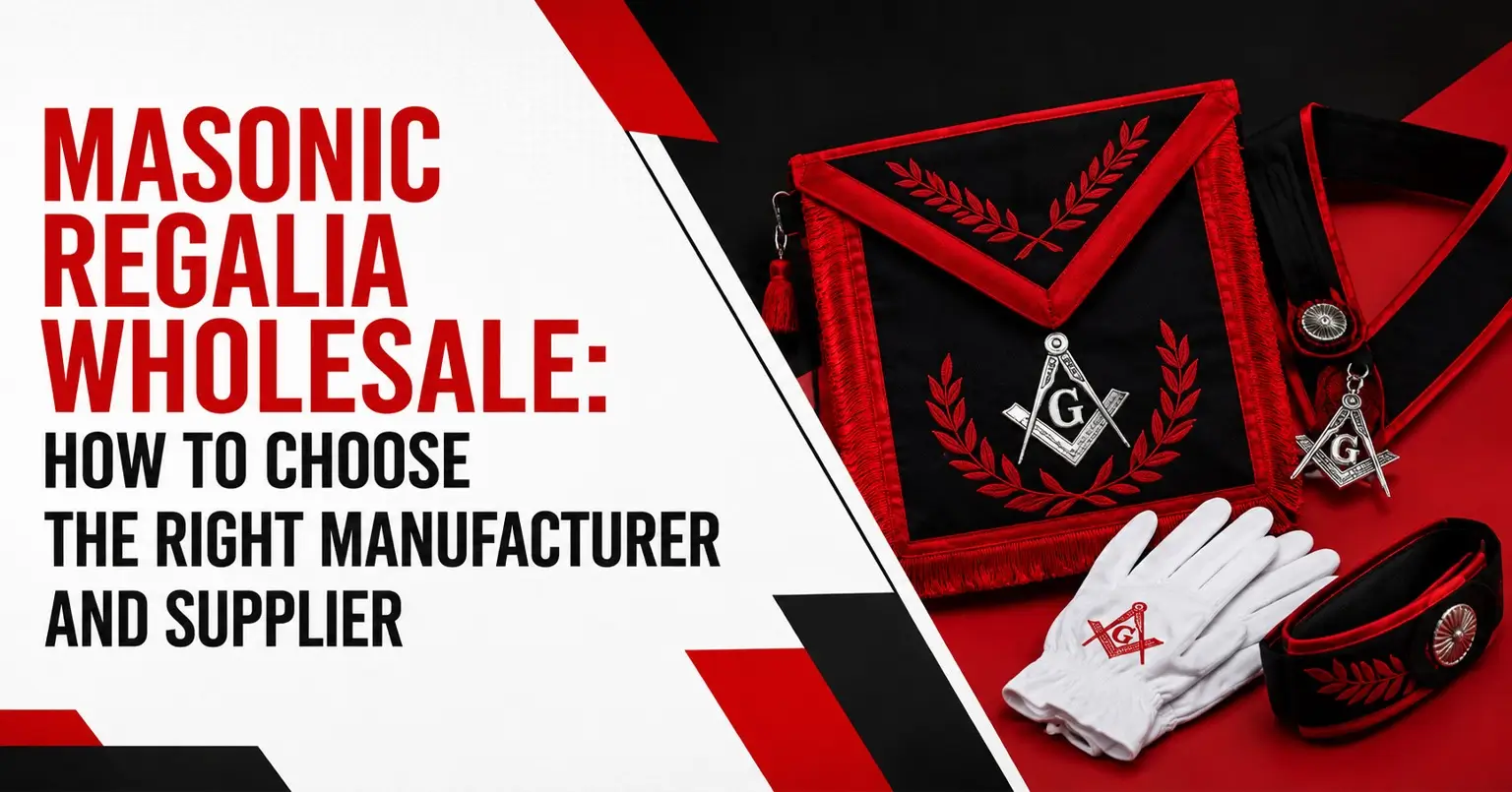
Masonic Regalia Wholesale: How to Choose the Right Manufacturer and Supplier
What to evaluate before you commit to a regalia manufacturing partner — from materials to MOQs to lead times.
When I planned to start my own Masonic Regalia wholesale apparel business, the only question that was on my mind every time was how to choose the right manufacturer and supplier, and where to find it. Each product carries deep symbolic meaning.
All your customers, from lodge members to retailers, want authenticity and durability. One consignment of poor quality will damage your reputation fast.
When the market is full of suppliers, the challenge is to find a reliable regalia manufacturer who is a master craftsman. So how do you find one with whom you can partner? Let’s check out what to look for when choosing a wholesale supplier.
Why Your Choice of Masonic Regalia Wholesale Supplier Matters More Than You Think
Here’s the reality: Masonic regalia isn’t a commodity. It’s ceremonial, symbolic, and often worn during rituals that matter to the wearer. A flimsy collar or a crooked emblem isn’t a defective product — it’s a disappointment that reflects on you as a supplier.
For retailers and wholesalers, the stakes are even higher. Your margins depend on consistent quality, competitive pricing, and reliable delivery. A bad supplier can mean:
- Chargebacks and returns from unhappy customers.
- Lost repeat business as lodges take their orders elsewhere.
- Wasted time chasing orders and fixing mistakes.
Choosing the right partner from the start saves you from all of it.
What to Look for in a Masonic Regalia Wholesale Manufacturer?
Not all manufacturers are created equal. Here are the non-negotiable areas to evaluate before you commit.
Material Quality and Craftsmanship
This is where many buyers get burned. Regalia that looks good in a product photo can feel cheap and fall apart in real life.
What to check:
- Leather and faux leather: for aprons — for example, craft regalia — genuine lambskin is the gold standard. It should be supple, not plasticky. High-grade faux leather is acceptable for budget lines but should still feel good-quality.
- Fabric and moire: collars and sashes should use quality moire or velvet that holds its texture and color. Thin, flimsy fabric will wrinkle and look cheap.
- Embroidery: this is the heart of Masonic regalia. Look for tight, clean stitching with no loose threads. Bullion wire embroidery (gold or silver metallic thread) should be dense and even. Ask whether the manufacturer uses multi-needle digital machines, hand embroidery, or a combination — hand embroidery offers superior detail for complex emblems.
Pro tip: always request physical samples before placing a bulk order. A sample tells you more than a hundred product descriptions.
Customization Capabilities (OEM/ODM)
If you’re a retailer or private-label buyer, you need a manufacturer that can execute your specific designs. Standard stock items won’t differentiate your store.
Key questions to ask:
- Do they accept custom artwork and logos?
- Can they match Pantone colors for ribbons and fabrics?
- Do they offer OEM (your design, their production) or ODM (their design, your branding) services?
- How accurate are their mockups? Do they provide digital proofs before production?
A competent manufacturer will walk you through a clear process: consultation, design mockup, sample production, approval, and bulk manufacturing. Avoid suppliers that are vague about customization or push you toward off-the-shelf items only.
Small Order Quantities (MOQs)
MOQs can make or break your buying strategy, especially if you’re testing a new product line or serving smaller lodges.
- Some manufacturers want high MOQs (e.g., 500–1,000 pieces).
- Others are more flexible, accepting orders as low as 2–10 pieces for trial batches.
What works for you:
- If you’re a large wholesaler with established demand, high MOQs might be fine; they usually come with better per-unit pricing.
- If you’re a smaller retailer or prefer to test the waters, look for suppliers with low MOQs. They allow you to diversify your inventory without overcommitting.
Smart Regalia positions itself as a custom manufacturer. We handle both small and bulk orders, which gives buyers flexibility.
Smart Regalia positions itself as a custom manufacturer. We handle both small and bulk orders, which gives buyers flexibility.
Contact Us to Start Your OrderProduction Lead Times and Shipping Reliability
In wholesale, time is money. A manufacturer that delivers late every time forces you to hold more safety stock or disappoint your customers.
What to clarify upfront:
- Sample production time: how many days for a prototype?
- Bulk production time: how long from order approval to dispatch?
- Shipping methods and estimated transit times to the USA.
- Do they provide tracking and proactive updates?
Efficient manufacturers deliver samples within 7–10 days. Bulk orders may take 4–8 weeks depending on complexity and volume. Get these timelines in writing.
Quality Control and Consistency
One perfect sample doesn’t guarantee a perfect batch. You need a manufacturer with rigorous quality control (QC) processes.
Ask about:
- In-process inspections: do they check materials and workmanship during production?
- Final inspections: does every piece get checked before packaging?
- Defect rates and return policies: what happens if a batch fails to meet specifications?
Some manufacturers advertise ISO 9001 certification — a good sign of structured quality management. Others offer guarantees on their craftsmanship, which reflects confidence in their work.
Communication and Responsiveness
This is often overlooked but critical. A manufacturer that’s slow to reply to emails or vague in their answers will cause you endless frustration.
Test them before you buy:
- Send an inquiry — how fast do they respond?
- Are their answers clear and detailed, or generic and evasive?
- Do they assign a dedicated account manager or point of contact?
Good communication prevents misunderstandings about specifications, deadlines, and costs.
Experience and Specialization
Masonic regalia is a niche. A general apparel factory won’t understand the specific requirements — correct emblem placement, degree-specific designs, or Grand Lodge regulations.
Look for:
- Years of experience in Masonic regalia.
- A portfolio showing a wide range of products (aprons, collars, jewels, caps, gloves, etc.).
- Testimonials or case studies from other wholesalers or retailers.
Manufacturers based in traditional regalia-producing regions like Sialkot, Pakistan often have deep expertise passed down through generations. Whether you want OES Regalia or any other regalia, you’ll get the best quality this way.
Red Flags to Avoid
Watch out for these warning signs:
Smart Regalia: A Trusted Buyer for Custom Regalia
You are looking for a custom Regalia manufacturer. Yes, it is not easy to find. That’s where Smart Regalia steps in as a reliable, trusted source for manufacturing — from established brands to startups and small businesses.
We provide the same quality every time, no matter what your order size is: premium materials, hand craftsmanship, and traditional artistry with modern precision. We offer low MOQs, unlimited customization, and flexible terms. From retailer to private label, we don’t just promise — we deliver.
Looking for a regalia manufacturing partner you can trust? Partner with Smart Regalia and experience the difference that genuine craftsmanship, flexible MOQs, and dedicated customer service make.
Partner With Us TodayConclusion
Choosing the right manufacturer for your Masonic Regalia is not complicated. It only needs you to understand the right approach. Your focus should not be only the price, but material quality, customization, MOQs, lead times, and experience.
Ask for samples before a bulk order for a quality check. Your reputation depends on the quality you deliver. So, partner with a manufacturer who treats quality and craftsmanship as seriously as you do.
FAQs
What is the typical MOQ for Masonic regalia wholesale?
MOQs vary widely. Some manufacturers require 500+ pieces per design, while others accept orders as low as 2–10 units for trial batches. It depends on the supplier and the complexity of the item.
How can I verify the quality of a Masonic regalia supplier?
Request physical samples before placing a bulk order. Also, ask about their quality control process, material sources, and whether they offer any guarantees on craftsmanship.
What materials are used for high-quality Masonic aprons?
The standard for quality aprons is white lambskin leather or high-grade faux leather, often bordered with sky-blue ribbon or velvet. Check for supple texture and precise stitching.
How long does it take to produce a custom Masonic regalia order?
Sample production typically takes 7–10 days. Bulk production can take 4–8 weeks depending on the order size, complexity, and the manufacturer’s current workload.
Can I get my own branding or logo on Masonic regalia?
Yes, most manufacturers offer OEM/ODM services. You can provide your artwork, and they will embroider or print your logo or design on the regalia. Always request a digital mockup for approval first.