

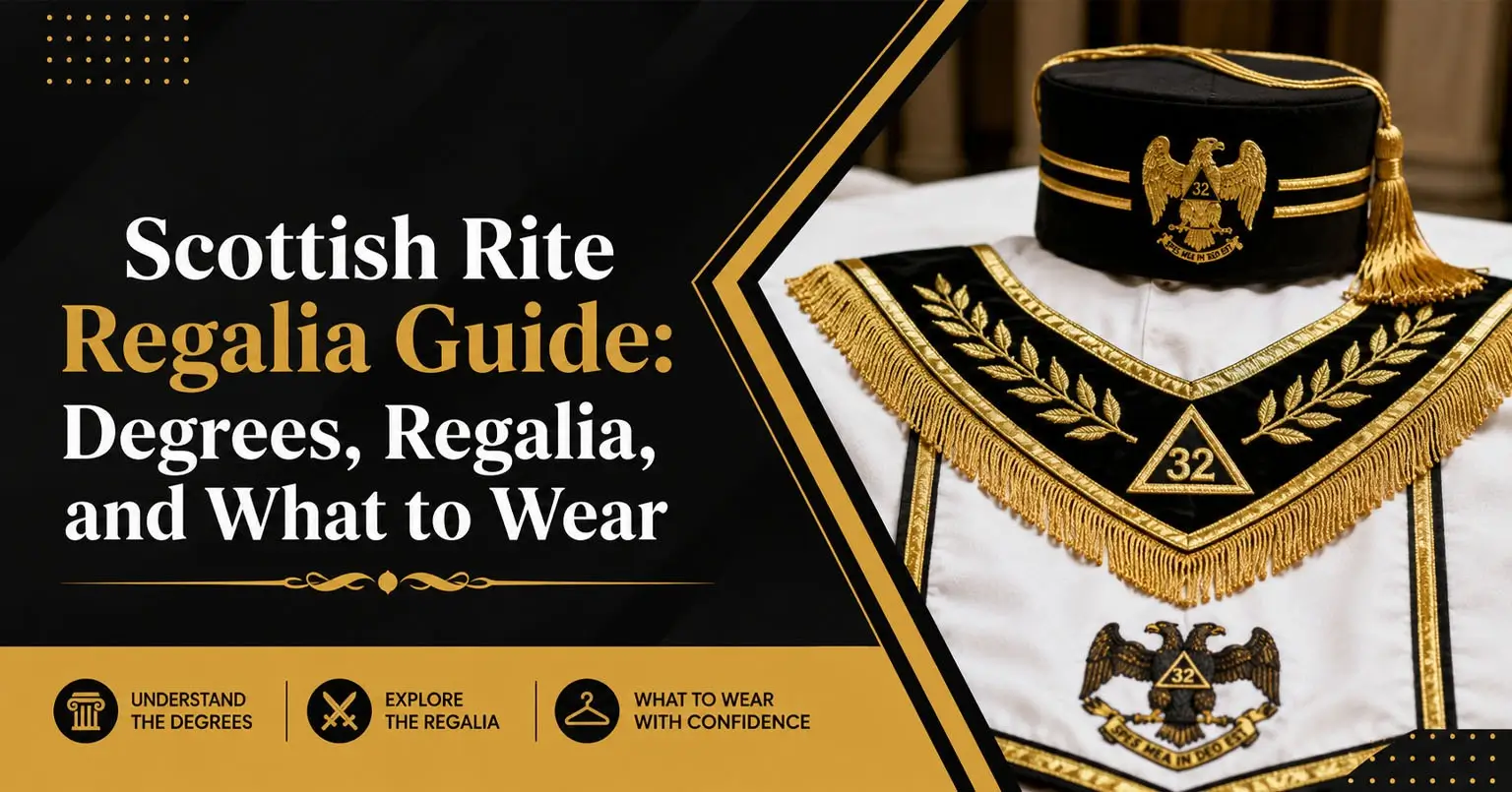
Scottish Rite Regalia Guide: Degrees, Regalia, and What to Wear
Standard degrees, higher-degree orders, and officer sets — what to stock, and what to avoid getting wrong.
Buying Scottish regalia can feel hard. Design changes for every degree, and the color changes too. The caps, jewels, and accessories — everything changes at every stage. If you order the wrong item, you may have to wait weeks to replace it. Sometimes you even waste money and time.
Which pieces you actually need and how to find a reliable supplier for you — whether you buy for yourself, stock for a shop, or private label — it is important to learn what kind of regalia belongs to your body.
Understanding Scottish Rite AASR Higher Degrees
The Scottish Rite AASR, or Ancient and Accepted Scottish Rite, is not only about the 4th through 32nd degrees. There are higher degrees and appendant bodies that exist outside the main structure.
When we talk about higher degrees, we are usually referring to the 33rd degree and the governing bodies that oversee the rite. But there are also appendant orders that work alongside the Scottish Rite. These include:
- The Scottish Masters of St. Andrew
- The Order of the Royal Secret (in some jurisdictions)
- The Memphis Misraim rite (in certain areas)
Each has its own regalia. Each has its own colors, jewels, and officer requirements.
For retailers and wholesalers, this is where the market gets interesting. These pieces are harder to find. That means customers are willing to pay more — if they locate a supplier who actually understands the details.
What Is the Scottish Rite AASR?
The AASR stands for Ancient and Accepted Scottish Rite. It is the full name of what most people simply call the Scottish Rite.
The system operates in two main jurisdictions in the United States: the Southern Jurisdiction and the Northern Jurisdiction. Both use the 4th through 32nd degree structure. The 33rd degree is honorary in both.
The AASR is also active internationally. Different countries have different structures. Some include more degrees or appendant orders that are not common in the United States.
This matters for regalia buyers. International customers often need pieces that American suppliers do not stock. If you can source regalia for AASR for international jurisdictions, you open a door that many competitors ignore.
Scottish Masters of St. Andrew: The Forgotten Order
The Scottish Masters of St. Andrew is one of the least understood orders in the Scottish Rite family. It operates in some jurisdictions as a degree between the 18th and 19th degrees. In others, it is a separate appendant order.
The regalia for the Scottish Masters of St. Andrew is distinct. It does not match the standard Scottish Rite color scheme.
Common elements include:
- A green or dark green apron
- Specific jewels that show the order’s emblem
- Officer collars and jewels for the presiding officers
The green color is the key differentiator. Most Scottish Rite bodies use white, blue, red, black, or purple. The Scottish Masters of St. Andrew breaks that pattern with green.
This is why buyers find it hard. They see a green apron and assume it belongs to another order. Or they order a standard Scottish Rite apron and realize it is wrong when they arrive at the meeting.
For suppliers, this is an opportunity. If you stock correct Scottish Masters of St. Andrew regalia, you become the go-to source. Only a few retailers carry it.
What Are Scottish Rite AASR Officer Sets?
Every Scottish Rite body has officers. The Lodge of Perfection has a Thrice Potent Master. The Chapter of Rose Croix has a Wise Master. The Council of Kadosh has a Commander. The Consistory has a Master of Kadosh.
Each officer wears specific regalia. That regalia belongs to an officer set. A full officer set usually includes:
- A collar or sash in the body’s color
- A jewel that shows the officer’s specific role
- Sometimes a special apron or cap
The jewels are the most important part. The Thrice Potent Master wears a different jewel than the Senior Warden. The Wise Master wears a different jewel than the Captain of the Guard.
If you are buying officer sets, you need to know which jewel goes with which office. Sending the wrong jewel to a lodge creates a real problem. The officer cannot wear it. The lodge has to reorder. The money and trust both will be lost.
If you want a supplier who provides the exact match, Smart Regalia specializes in these details. We build officer sets that match the exact requirements of each body and each office.
Contact Us For A Free QuoteMemphis Misraim: The Rarest Rite in Regalia
Memphis Misraim is not part of the standard Scottish Rite AASR system. It is a separate rite with its own history, degrees, and regalia. But people mention it alongside Scottish Rite regalia because the two share historical roots.
The Memphis Misraim rite includes a large number of degrees. In some systems, it goes up to 90 or more degrees. The regalia for these degrees is special and difficult to find.
Common pieces include:
- Aprons with Egyptian symbolism
- Collars with specific jewels for each degree
- Sashes and cords that show rank
The Egyptian influence is strong. You see pyramids, sphinxes, and other Egyptian motifs. They do not appear in standard Scottish Rite regalia.
This is a niche market. A few suppliers produce Memphis Misraim regalia. The demand is small but steady. Customers who need it are usually desperate to find a reliable source. They will pay premium prices for correct pieces.
For a private label or wholesale operation, Memphis Misraim is risky. The market is small. But if you can serve it correctly, you face almost no competition.
Higher Degree Regalia vs. Standard Scottish Rite Regalia
Let us be clear about the difference between standard Scottish Rite regalia and higher degree regalia.
Standard Scottish Rite regalia covers the 4th through 32nd degrees. The colors are predictable. The designs are well-known. You can find dozens of suppliers.
Higher degree regalia covers the appendant orders, the officer sets, and the rare rites. The designs are less common. The details are more specific. You may only find one or two suppliers who get it right.
Here is a quick comparison:
| Feature | Standard Scottish Rite | Higher Degree and Appendant |
|---|---|---|
| Availability | Widely available | Hard to find |
| Color scheme | White, blue, red, black, purple | Varies by order, includes green and other colors |
| Officer jewels | Standard for each body | Specific to each office and order |
| Buyer knowledge | Most buyers know what they need | Many buyers need guidance |
| Competition | High | Low |
The opportunity is clear. Standard regalia is a crowded market. Higher degree and appendant regalia is open. If you can serve it accurately, you build a loyal customer base.
What to Look for in Higher Degree Regalia
The rules for buying higher degree regalia are the same as standard regalia. But the stakes are higher. These pieces are harder to replace. A mistake costs more time and money.
Correct Symbols
The emblems on higher-degree regalia are specific. The Scottish Masters of St. Andrew use a particular symbol. Memphis Misraim uses Egyptian motifs. If the symbol is wrong, the whole piece is useless.
Ask your supplier for a proof before production. A good supplier will send you an image or drawing for approval. If they will not show you the design before you pay, walk away.
Accurate Colors
We mentioned the green used by the Scottish Masters of St. Andrew. That green has to be the right shade. Too light, and it looks like a different order. Too dark, and it looks almost black.
The same applies to officer set colors. The red in a Rose Croix collar should match the red in the apron. Mismatched colors look unprofessional.
Quality of Jewels
Officer jewels are the centerpiece of an officer set. They need to be clear, detailed, and properly attached. Cheap jewels fall off. Badly cast jewels look blurry.
Look for jewels made from quality metal with sharp details. The enamel or color fill should be even and durable.
How to Source Higher Degree Regalia for Retail?
If you are a retailer or wholesaler, sourcing higher degree regalia requires a different approach than standard pieces.
Find a supplier who actually knows the orders
Ask them specific questions. What is the correct color for a Scottish Master of St. Andrew apron? What jewel does the Thrice Potent Master wear? If they cannot answer immediately, they are not the right supplier.
Order in small quantities first
Higher degree regalia does not sell as fast as standard 32nd degree pieces. You do not want to sit on inventory that takes years to move. Test the market with a few pieces, then scale up.
Educate your customers
Many buyers do not know exactly what they need. They know they need something for the Scottish Masters of St. Andrew, but they do not know the exact jewel or color. If you can guide them, you earn their trust and their repeat business.
Common Mistakes Buyers Make
We see the same mistakes over and over. Here are the big ones.
Assuming All Scottish Rite Regalia Is the Same
It is not. The Scottish Masters of St. Andrew is not the same as the Lodge of Perfection. Memphis Misraim is not the same as the Scottish Rite AASR. Each has its own system.
Buying the Wrong Officer Jewel
Officer jewels are specific. The jewel for the Senior Warden is not the same as the jewel for the Junior Warden. If you are buying an officer set, confirm the exact office before you order.
Ordering Without Checking Jurisdiction
The Southern Jurisdiction and Northern Jurisdiction have slight differences. International jurisdictions have more differences. What works in one jurisdiction may not work in another. Always confirm the jurisdiction before ordering.
Choosing Price Over Accuracy
Higher-degree regalia is hard to find. Some buyers grab the cheapest option they can find, only to discover the design is wrong. Cheap and wrong is more expensive than correct and slightly more expensive.
Smart Regalia: A Trusted Supplier for Scottish Rite Regalia
Finding a supplier who understands the technicalities of Scottish Rite Regalia is rare. Smart Regalia is not like ordinary suppliers. We know the degrees, the colors, and the jewels. We know how an apron of St. Andrew is different from higher degrees. We also know the color scheme of every house and the theme of each degree.
We provide regalia for individual members, retailers, and private labels. We make every piece with care and finish with attention to detail. We recheck each product for quality assurance. When you need regalia that looks right and sharp, Smart Regalia is the name you can trust.
Need specialized Scottish Rite AASR regalia? Browse our collection to find options that suit you. We provide both OEM and ODM services for lodges and private label.
Browse Our CollectionConclusion
The world of Scottish Rite Regalia and its different houses is complex. But this also creates an opportunity. What buyers need is a supplier who understands the details. For retailers and private labels, the key is to serve a niche that competitors often ignore. A supplier like Smart Regalia is your strategic step to dominate the market.
FAQs
What does AASR stand for in Scottish Rite?
AASR stands for Ancient and Accepted Scottish Rite. It is the full formal name of the Scottish Rite system used in most jurisdictions worldwide.
What is the Scottish Masters of St. Andrew?
The Scottish Masters of St. Andrew is an appendant order connected to the Scottish Rite in some jurisdictions. It often uses green regalia, which sets it apart from the standard Scottish Rite color scheme.
What is Memphis Misraim?
Memphis Misraim is a separate rite with Egyptian influences and a large number of degrees. It is not part of the standard Scottish Rite AASR system, but it shares historical connections and is often requested alongside Scottish Rite regalia.
What is included in a Scottish Rite officer set?
A Scottish Rite officer set typically includes a collar or sash in the body’s color and a jewel that identifies the specific office. Some sets also include a matching apron or cap.
Do I need different regalia for the Scottish Masters of St. Andrew?
Yes. The Scottish Masters of St. Andrew uses its own regalia, often featuring green aprons and specific jewels. Standard Scottish Rite regalia is not correct for this order.